Which way does a traverse misclosure point?
Distinguish the endpoint residual from the return vector using a 130 mm closing gap and two explicit station coordinates.
−50 mm north · +120 mm east · 130 mm residualOn this page
Put the two positions on paperFind the bearing of the gapReproduce the same discrepancy without coordinatesDescribe the result so another person can act on it“The misclosure is toward the southeast” leaves an important question unanswered. Does southeast describe where the computed endpoint landed, or where the crew should look from that endpoint to find the intended mark? Both descriptions can appear in software reports. They refer to opposite directions on exactly the same short line.
Put the two positions on paper
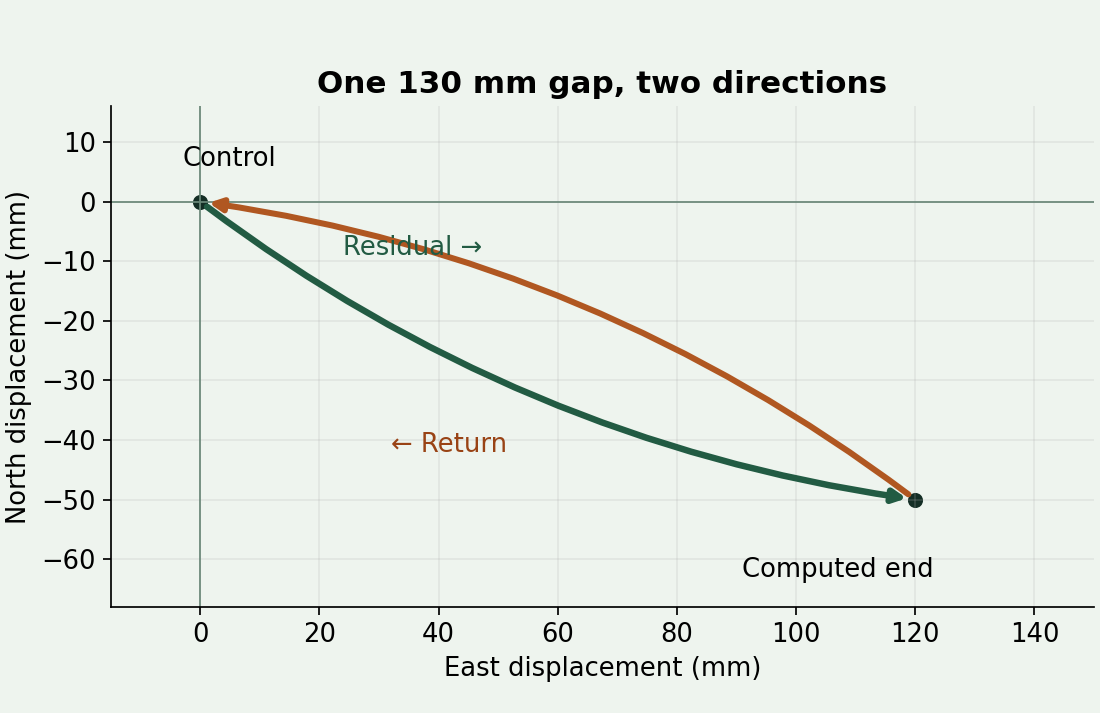
Suppose a loop starts on control A at N 1040.000 m, E 875.000 m. After the last observed course the running coordinates read N 1039.950 m, E 875.120 m. Keep the original start and the computed return as separate rows even if your field book uses A for both station names.
| Difference being computed | North | East |
|---|---|---|
| Computed end minus intended A | −0.050 m | +0.120 m |
| Intended A minus computed end | +0.050 m | −0.120 m |
The first line says the computed return falls south and east of control. The second line gives the displacement from that computed position back to A. Take the hypotenuse using either row. The answer is 0.130 m, a scaled 5–12–13 triangle. Reversing both signs preserves the distance.
Find the bearing of the gap
For the first row, the acute angle measured from south toward east is arctan(0.120 / 0.050), or about 67.380°. The quadrant bearing is S 67.380° E. For a clockwise azimuth from north subtract that angle from 180°, giving 112.620°. Turning to face back along the discrepancy gives an azimuth of 292.620°, or N 67.380° W.
A spreadsheet can calculate the azimuth in a single step, but its ATAN2 argument order deserves a separate test. Give your formula a displacement due east. It must produce 90°. Give it a displacement due north. It must produce 0°, or its equivalent 360°. Different spreadsheet and programming interfaces put the two arguments in different positions. Those two cardinal tests catch a swap immediately.
Reproduce the same discrepancy without coordinates
Paste these synthetic observations into Traverse Desk. The calculator uses a local starting origin, which is enough for a loop difference.
0, 46.950
90, 62.120
180, 47.000
270, 62.000
Add north-going distances and subtract south-going distances. Do the same independently for east and west. You recover the first row of the table and the plotted gap of 0.130 m. The web result reports the magnitude. Keep the component sheet for a directional diagnosis. On a drawing at ordinary scale those final 13 centimetres can disappear into the line width of a 62 m side.
Describe the result so another person can act on it
Try wording the field note as a complete observation. “Computed return falls 0.050 m south and 0.120 m east of A.” If the following line gives a correction, name its origin explicitly. “From computed return to A, N 67.380° W, 0.130 m.” Someone reading this tomorrow can reconstruct both sign conventions without seeing your screenshot.
A closing vector describes two positions. It does not identify the course that was measured incorrectly. Several small distance errors, an angular error on a long leg, or a bad terminal control coordinate can produce the same vector. Before distributing a correction, verify the station IDs and the direction from which each observation was recorded. A residual pointing roughly along a course can make that course worth checking. It cannot establish the correction to enter without supporting evidence.
One final independent check is to add the return components to the computed endpoint. In this example 1039.950 + 0.050 returns 1040.000 north, and 875.120 − 0.120 returns 875.000 east. If the calculation doubles the gap, the report has mixed residual and correction conventions.